
Best Plants for Windowless and Low-Light Bathrooms
A bathroom without a window can still include living plants, but no plant can grow in complete darkness indefinitely. In a windowless room, provide a suitable artificial light source or move plants periodically to a brighter location. The options below are commonly chosen for their tolerance of lower-light indoor settings.
Quick Guide
Choose plants based on the light available, the amount of shelf or floor space, and how often you tend to water. Upright plants work well in narrow areas, while trailing plants suit high shelves or hanging planters. Keep pots away from frequently splashed surfaces, check the soil before watering, and watch for changes such as stretched growth, fading leaves, or persistently wet soil.
Plants That Work in Low-Light Bathrooms
Low-light tolerance does not mean that a plant needs no light. If your bathroom has no natural light, plan for artificial lighting and reassess the location if the plant begins to decline.
Peace Lily (Spathiphyllum)

The peace lily has broad, glossy leaves and distinctive white flowers. Its full foliage suits an open counter, plant stand, or floor position where the leaves will not be crowded. It tolerates lower-light conditions, although flowering may vary with the growing environment. Check the soil before watering rather than watering on a fixed schedule, and avoid leaving it continuously saturated.
Snake Plant (Sansevieria trifasciata)
The snake plant has stiff, upright leaves with striped or patterned markings. Its vertical shape is practical beside a vanity, in a narrow corner, or anywhere a trailing plant would obstruct the room. It tolerates low light and infrequent watering, but a windowless bathroom still requires an artificial light source. Keep it out of reach of pets that may chew plants.
Chinese Evergreen (Aglaonema)
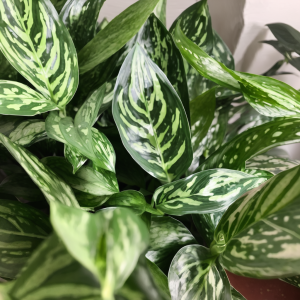
Chinese evergreen offers dense foliage in a range of green and variegated patterns. It works well where a compact, leafy plant can soften hard bathroom surfaces without taking up much floor space. Place it in indirect or artificial light, turn the pot occasionally for more balanced growth, and keep it away from pets that may chew the leaves.
Pothos (Epipremnum aureum)

Pothos has heart-shaped leaves that may be solid green or variegated. Its trailing growth makes it useful on a high shelf or in a hanging planter, especially when counter space is limited. Make sure the vines do not interfere with doors, mirrors, or frequently used storage. Allow the upper soil to dry somewhat before watering, and keep the plant away from children and pets that might chew it.
Spider Plant (Chlorophytum comosum)

Spider plants have arching green leaves and produce small plantlets on long stems. Their spreading shape is best suited to a hanging planter or a shelf with clear space around it. The offsets can be separated and potted when they are ready. Check that the leaves and stems are not pressed against wet surfaces or caught in cabinet doors.
ZZ Plant (Zamioculcas zamiifolia)

The ZZ plant has thick stems lined with smooth, glossy leaflets. Its upright form provides greenery without trailing across storage or work surfaces, making it a practical option for compact bathrooms. It tolerates lower-light settings and may grow slowly there. Let the soil dry somewhat between waterings rather than assuming bathroom humidity replaces normal soil checks.
Cast-Iron Plant (Aspidistra elatior)

The cast-iron plant has long, dark green leaves and a substantial upright shape. It is better suited to a floor position or broad plant stand than a crowded vanity. It tolerates low-light conditions and does not need constant attention, but it should still receive an appropriate light source in a windowless room. Avoid watering again while the soil remains wet.
Dracaena 'Janet Craig' (Dracaena deremensis 'Janet Craig')

Janet Craig dracaena has narrow, upright leaves that add height without the visual spread of a trailing plant. Use it in a corner or beside a vanity where its leaves have room to extend. It handles lower-light indoor conditions, though growth may be slower. Check the soil before watering and keep the plant away from pets that might chew it.
Dwarf Umbrella Tree (Schefflera arboricola)

The dwarf umbrella tree has clusters of small leaves arranged along branching stems. It can provide more height and volume than a small shelf plant, so allow enough clearance around mirrors, cabinets, and walkways. Occasional pruning can help control its shape in a compact bathroom. Keep it away from children and pets that may chew plants.
Chinese Money Plant (Pilea peperomioides)

The Chinese money plant is recognized by its round, coin-shaped leaves. Its compact form fits neatly on a shelf or vanity with enough clearance around the foliage. Turn the pot periodically if growth leans toward the available light. Check the soil before watering, and move the plant if it shows signs that the location is too dark.
How to Choose a Plant for a Windowless Bathroom
Start with the room's actual light source rather than selecting by appearance alone. For a bathroom with no window, decide where artificial light can reach the plant and avoid placing it in a permanently dark corner. Next, match the plant's shape to the layout: use upright foliage in narrow spaces, compact plants on vanities, and trailing plants on secure shelves or in hanging planters. Also consider whether children or pets can access the leaves.
Choose a pot location that is easy to inspect and water without moving toiletries each time. A visible position also makes it easier to notice leaning growth, damaged leaves, or soil that stays wet. If several plants share a small bathroom, leave enough space around them for routine cleaning and access to storage.
Common Mistakes
- Treating low-light tolerance as the ability to live in complete darkness.
- Watering on a calendar without first checking whether the soil is still wet.
- Assuming bathroom humidity means the plant never needs normal soil care.
- Placing spreading leaves or trailing vines where they block mirrors, cabinets, or walkways.
- Ignoring access by children or pets when choosing and positioning a plant.
Frequently Asked Questions
Can plants live in a bathroom with no window?
They can be kept in a windowless bathroom only if they receive light from another appropriate source or are regularly moved to a brighter setting. Ordinary room darkness is not enough for long-term growth.
Which plant shape is best for a small bathroom?
Upright plants such as snake plants or ZZ plants use limited horizontal space. Compact plants suit shelves and vanities, while trailing plants work best when they can hang without obstructing storage or movement.
Does bathroom humidity replace watering?
No. Check the potting soil directly and water according to its condition. Humid air does not guarantee that the roots have the right amount of moisture.
Where should I place a bathroom plant?
Choose a stable spot that receives the available light and stays clear of doors, cabinet fronts, and frequently splashed surfaces. Keep enough room around the plant for cleaning and routine care.
What should I do if a plant struggles in the bathroom?
Reassess its light, soil moisture, and placement. Moving it to a brighter location or choosing a plant better matched to the room may be more effective than adding extra water.



0 Kommentare